
As we wrap up Project 2: Profiling a Social Entrepreneurship Company, I have a few reflections regarding what I believe it means to be a social enterprise in this day and age.
Who did you initially choose to present on and why?
My initial presentation was one two different companies: That’s Caring and OneHope. Last year during a management class at school, we had a social entrepreneur come in and speak to our class. He was the co-founder of That’s Caring, a company that sells gift baskets and gives away a weekend bag full of meals for food insecure students across America. While I was exploring their website, I noticed part of their gift options included a bottle of wine with a whole different mission. That’s Caring teamed up with OneHope, a social enterprise that makes and sells wine with a purpose.
I presented both of these in class to my peers because I liked that the social missions behind both companies were front and center in the businesses every day work. I also found them both unique and interesting and thought they would fit well with the project perimeters. Something as simple as online shopping for your loved one’s birthday or buying a bottle of wine can have a deeper impact because of these enterprises.


What did you learn from discussing the other companies both with the members of your group specifically and the class generally?
There are many definitions as to what it means to be a social enterprise and that became apparent through our discussions as a group and class. Lexi presented on Reach Capital, a company who invests in educational startups which got us into a debate as to whether we can consider any company who has an educational mission can and should fall under a social enterprise. One member was adamant that under these guidelines, a business such as Wikipedia and Khan Academy should be counted as one of the most successful and powerful social companies.
Interesting conversations during small group presentations arose as well. All members were impressed by the ingenuity of Spoiler Alert, an app that connects food distributors with individuals like homeless shelters who could put expired food products to good use. The most lucrative discussion occurred during Group 3’s presentations on GoodGoodGood and SocialWorks. Both business models proved to be extremely impactful and positive but they posed the question of what we can put under the umbrella of a social enterprise. In the end, I came up with my own individual conclusions. Although GoodGoodGood may not be seen as your traditional socially impactful company, they are doing just that. By spreading positive news and sharing happiness in a world that desperately needs it, they are being socially responsible and making an impact. On the other hand, I don’t think SocialWorks can be considered a social enterprise. I’d say that it falls more under the line of a charity. Having the celebrity impact of Chance the Rapper is what makes the foundation successful and I question their ability to fund and make an impact if and when Chance would ever stop being involved as the main funding source.

Do you agree with Alter’s criteria for delineating the various enterprise models, and do you find it helpful to analyze companies in this way?
For the most part, I agree with the criteria using to describe the various enterprise models. Sometimes I think it can be difficult to decide which category a specific business falls under, but when you are able to dig deeper and make a decision it can help to determine mission and have a more focused business.
Alter describes various enterprise models that make it helpful to focus on the underlying message of companies because you know more about it. For example, it became easier for our group to determine the similarities and differences between the two companies we chose (Reach Capital and OneHope) once we decided which models these companies fell under. Having a specific definition for the model types provides clarity.
The only downside to this process that I see is for companies who either fall under no model’s definition or they fall under multiple model definitions. Alter’s criteria certainly could limit what we consider social enterprises if they type of situation were to occur.
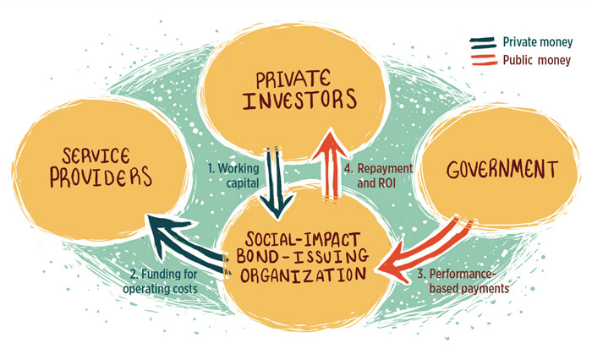
Specifically, with regards to Social Impact Bonds, what do you see as the key advantages and difficulties of this funding model?
Social Impact Bonds bring a new light to the possibilities available for funding social enterprises. However, challenges are present because of the freshness of the idea and the lack of ability to measure an impact. I will dive deeper into the pros and cons I believe exist with this funding model.
Pros:
- Projects that may not have gotten funding from a government source have a chance with the use of SIB. A government doesn’t have to take the risk they otherwise would have since they only have to pay the bond if the enterprise ends up being successful.
- SIB can lead to a more efficient way of funding and can be highly effective when it works out.
- Measurement is easier because there is set criteria the enterprise much meet in order to be paid back.
Cons:
- Although the measurements help in many ways, the actual setting of the criteria can be difficult, especially for some enterprises who are in business services that make it difficult to measure impact.
- SIB are still too young and new to know the long-term benefit of them.
- Motives for profit could potentially compromise the underlying social mission.
 Social Entrepreneurship Profile