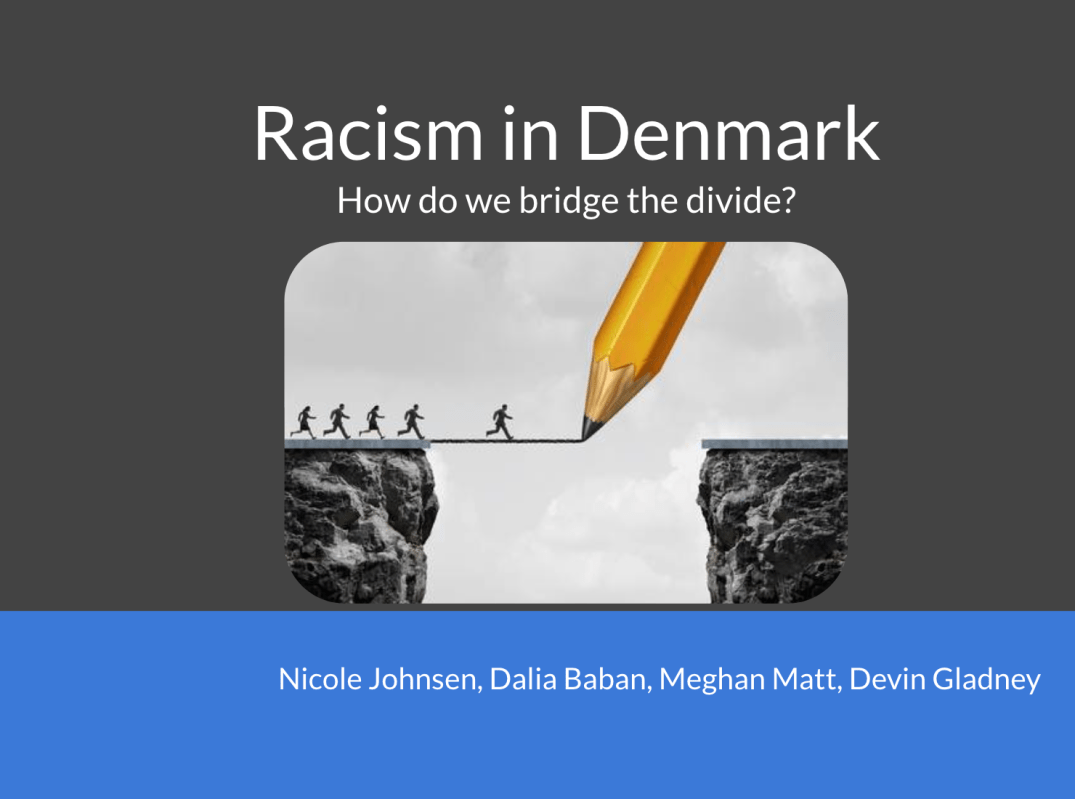

My group consisted of myself, Dalia, Nicole, and Devin. Our topic was immigration and racism in Denmark. Given the recent surge in refugees around the EU, Denmark specifically, there are issues to be addressed and problems to be solved. Our first step to creating a social enterprise that would bridge this racism gap was brainstorming. We set out to answer the following questions:
- What type of racism occurs in Denmark?
- How do Danes view refugees?
- What kind of laws does Denmark impose to protect Danish citizens and/or refugees/immigrants?
- Are Danish politics pro or anti immigration?
- Do social enterprises currently exist around Copenhagen that aim to solve similar problems?
Our initial thought was to create a cafe that employees immigrants and gives Danes the opportunity to get to know them and learn more about their background through coffee and pastries. After consideration, we decided to shy away from this solution. We thought that by having minorities serve Danes, they will be already put at a disadvantage.
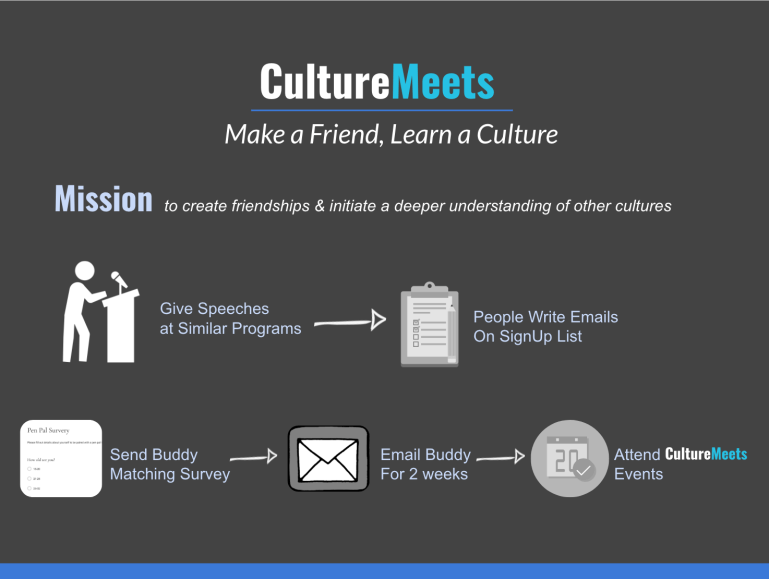
Finally, we came to an even better conclusion. What better way to get to know somebody than through writing. Our social enterprise, CultureMeets aims to integrate immigrants and minorities with Danes through a Pen Pal like system. Participants fill out a survey and they are set up with a partner who they are encouraged to get to know via email. After 2-3 weeks, partners have the opportunity to meet up at our CultureMeets events. The goal is to partner with local cafes/bars/restaurants to hold these events at.
Key insights from my classmate’s presentations:
- Clothing reuse groups
I loved both ideas presented on the Danes overconsumption of clothing. I’ve always known this is a problem but I thought both groups did a good job at backing up why this issue is important to find solutions for via data and research. They were both social enterprises that I would be willing to partake in if they existed. My favorite was the clothing rental business because it’s something many of us already do, sub-consciously. From experience, I enjoy sharing clothes with my friends. We borrow each other’s items and give them back when we’re done using them for an event, etc. Being able to lend out the clothes you don’t use regularly is a great way to make additional income & do good for the environment.
2. Teen Drinking
I was amused by this presentation because it aligned a lot with what my group is doing in Europe Business Strategy with Carlsberg and irresponsible drinking. I like their funding model and plan to partner with different foundations, such as the Obel Family Foundation’s whose main objectives is childhood intervention because they believe most of the social issues in Denmark start at a young age. I think the emphasis of the enterprise is smart to focus on increasing self-control as opposed to ending teen drinking. However, I’m still slightly confused by the overall project and some minor details of the social enterprise the boys in class came up with. I think they could have done a better job clarifying their idea.
Daniel’s Feedback:
Firstly, racism is obviously a very serious issue and one that needs to be clearly defined and treated with great care. Whilst I agree that certain policies enacted by the current government can be argued as being racist (i.e. targeting a group of people because of their ethnicity, race or religion) the presentation seemed to suggest that Danish society was in some way endemically racist. If you are going to make this point it needs to be done in a nuanced way, clearly defining what you mean by racism, and then coming with hard evidence to back up your statements. Whilst I agree 100% that there are serious integration problems in Denmark, this is a different issue to racism. The crucial factor in designing your project is evidencing an understanding of the social issue from the perspective of those involved, i.e. the Danes and the immigrants, and I didn’t get this, and I can see from the bibliography that very few sources were used when researching this issue.
This led to your idea itself. If it were based on aiding integration of immigrants, I totally get where you are coming from, but as I mentioned at the time it wasn’t clear how you would link up the people who typically have suspicious views of immigration (i.e. in the countryside in Jutalnd) with the immigrants (who are typically in urban centres). The comparables you came up to back up your idea are also both examples of integrating immigrants and refugees into the Danish population and workforce. I needed additional proof of concept however to see this as a potential solution to racism.
Because of this, the project at time felt oversimplified and based more on assumptions, rather than academic research into the issues you were looking to combat.
Personal Response
The main challenges of designing our own SE project were:
- Lack of information about the problem
- No first-hand experience as minority/immigrant in Denmark
- Avoiding assumptions
- Knowing what will be successful & receive good turnouts from locals
What I would do differently:
- Do more prior research to see where the need is in the market
- Give more thought to Danes in other areas of the country like Jutland
- Meet one time to do a run-through presentation instead of simply dividing the slides up and telling everybody to do their own part
- Definitely do a better job clarifying the message we were attempting to portray, which was not that Danes are overall racist
My key takeaways from the project:
- It’s better (and easier) to create a business/project when you are passionate about the subject
- Assuming how something will turn out or what the market needs is not good enough. Intense research needs to be done if you want to be successful.
- Being on the same page as other group members (or business partners in real life situations) is crucial or problems and confusions will surely arise.
- Be careful about how something is worded and how your audience will react to a message/idea.
 Social Entrepreneurship Profile